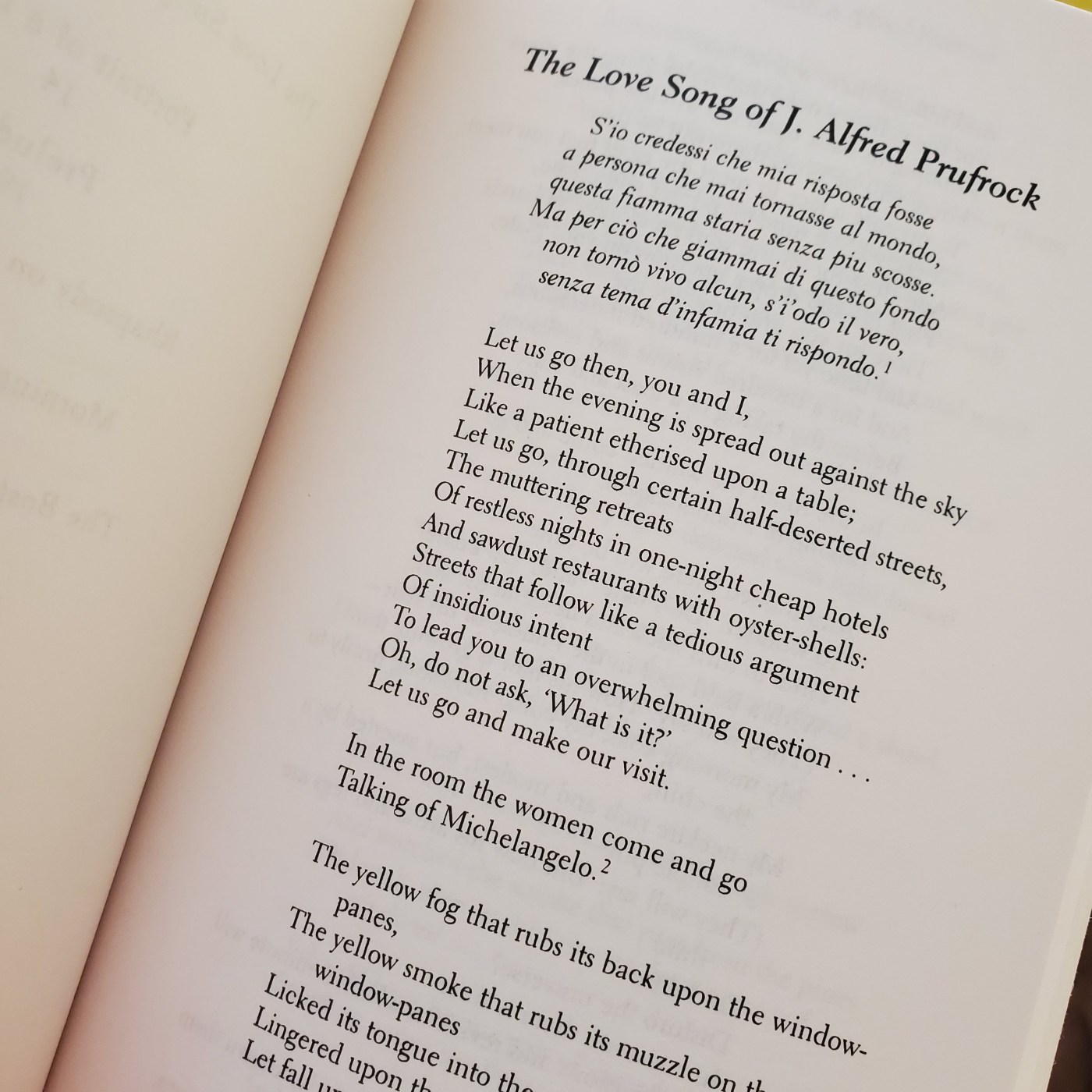
“The Love Song of J. Alfred Prufrock” by T.S. Eliot is one of my favorite poems. I first read it in my eleventh grade English class, where I was fortunate to have a teacher who made me learn to love studying and analyzing literature. I had always loved to read, but English classes in school were underwhelming, as we would never have those kinds of discussions where we talked about what a story or poem meant for us and what we could learn about life from it.
One reason I’ve been hesitant in the past to write reviews and discuss stories and poems I love is the fear that I’ve interpreted something wrong. I think of the line in this poem, “That is not what I meant at all.” But I’m going to talk about what Prufrock means to me, whether that’s what T.S. Eliot meant or not.
I approach any form of art from the eyes of a creator. Everything I read or hear or see influences my writing in some way. As the speaker of the poem, J. Alfred Prufrock questions whether he dares to disturb the universe, a question that echoes my doubts about whether I should put my work out into the world. There’s the fear too that his attempts to disturb the universe or “force the moment to its crisis” will fail.
There’s a sense too of not being of the world, which is something I feel quite often. Prufrock sees himself as an attendant lord or even the fool in a play, a character who’s there only to put something in motion for a more important character. He’s enchanted by the mermaids’ singing but does not think they will sing to him.
J. Alfred Prufrock lives in a bleak and mundane world, full of sleepy fog and the niceties of teas, everything prim and proper and deliberate. Where are the violent passions? Should he disrupt this quiet, delicate life? Would it be worth it to raise his voice? While dealing with these doubts, he grows old and resigns himself to the role of a bit player who serves a purpose in someone else’s heroic story.
For me, this poem is about the lack of confidence to exist fully in the world. It’s so easy to doubt that it would be worthwhile to take chances and to be afraid to “begin to spit out all the butt-ends of my days and ways.” It’s difficult to remember that this poem is supposed to be a love song, but I think he’s in love with the idea of escaping his doubts and his suffocating world. “Let us go then, you and I…”
I’m not sure how well I’ve done discussing this poem. Like Prufrock says in the poem, “It is impossible to say just what I mean!” Yet I return to this poem so often and find some comfort in it as I also worry if I dare disturb the universe.
 Michelle Wicklow